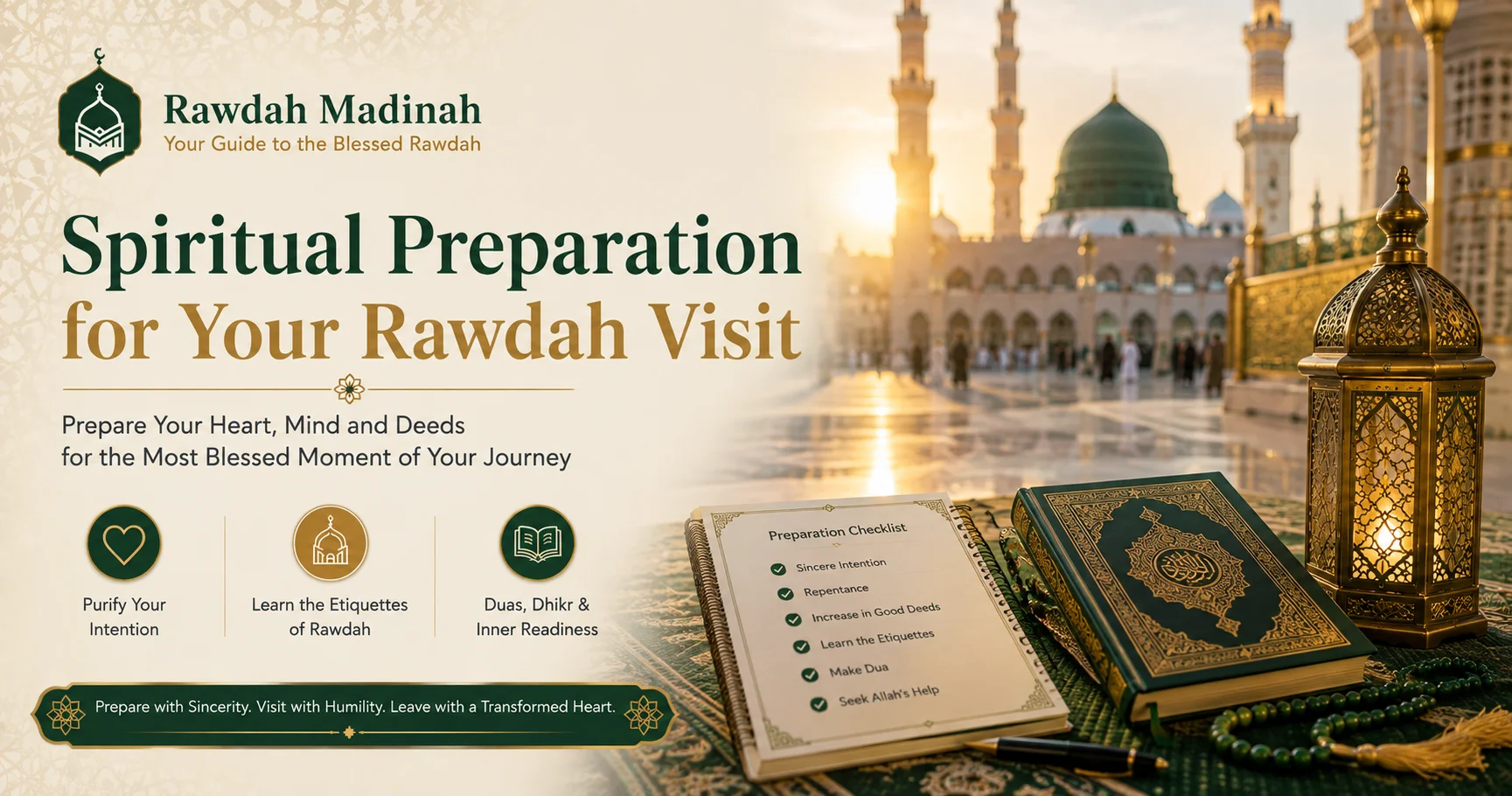
The difference between a visit to the Rawdah that changes your life and one you barely remember is not luck or timing. It is preparation. Hajj Safe puts it plainly: “When you enter the Rawdah, don’t rush. Take a deep breath. Let your heart settle. The preparation you do before stepping on that green carpet determines almost everything about what happens when you’re there.”
Spiritual preparation for the Rawdah begins not at the gate of Masjid Nabawi, not at your hotel in Madinah, and not on the flight to Saudi Arabia. It begins at home, in the weeks before departure, with a series of intentional acts that soften the heart and focus the soul. This guide gives you all of them.
Key Takeaways
📎 Full guide: Duas & Spiritual Guide — Complete Arabic duas with transliteration → rawdahmadinah.com/duas-to-recite-in-rawdah/
Full duas in Arabic, transliteration and English — including Sayyidul Istighfar, Durood Ibrahim, and duas for parents, health, rizq and Jannah
Why Preparation Transforms Your Visit
The Rawdah gives you 10 minutes. In those 10 minutes, everything depends on where your heart already is when you step onto the green carpet. A prepared heart — softened by weeks of salawat, focused by a written dua list, purified by wudhu, and settled by clear intention — arrives at the threshold ready. An unprepared heart spends half its 10 minutes catching up.
“Make dua with certainty that Allah will answer, and know that Allah does not answer the dua of a heart that is heedless and distracted.”
— Tirmidhi, Hadith 3479. Certainty comes from preparation. Preparation begins weeks before the green carpet.
Hajj Safe records what experienced pilgrims consistently say: the quality of your visit is set before you arrive. “Many righteous people have prayed here over the centuries — enter with reverence, not routine.” Reverence is not spontaneous. It is cultivated.
Phase 1 — Weeks Before You Travel
Increase salawat upon the Prophet ﷺ
You are preparing to visit the Prophet’s ﷺ city and stand in the space he identified as sacred. Begin sending salawat daily — after every salah, on your commute, before sleep. Prayertimesksa.com confirms: “Reciting salawat is one of the most recommended acts in Madinah — it softens the heart and creates a connection with the Prophet ﷺ before you physically arrive.” The heart that arrives having sent thousands of salawat is already connected.
Write your dua list — in detail
Begin your dua list weeks before departure. Not a vague list — a specific one. Every request, every person, every situation you want to bring before Allah. Amaliah advises: “Write down what you want to ask for yourself, for your family, for your deceased, for those who asked you to pray for them.” A detailed list prepared in your normal life carries more sincerity than one written in a hotel room the night before.
Learn about the Rawdah before you stand in it
Understanding what you’re entering transforms the experience. Read the foundational hadith (Sahih al-Bukhari 1196). Learn about the six sacred pillars, the Minbar, the Noble Chamber. Al-Zawar Travel emphasises: “Visiting Rawdah begins long before you touch the green carpet.” A pilgrim who knows why every inch of that space is blessed stands differently on it.
Increase istighfar (seeking forgiveness)
The weeks before a sacred visit are a time to clear the spiritual slate. Increase Sayyidul Istighfar daily. Ask forgiveness for specific sins you’re aware of. Return rights to anyone you owe them. The Prophet ﷺ said dua is not answered by a heart that is heedless — and unaddressed sin is one form of heedlessness. Arriving in Madinah with a lighter heart opens the chest for dua.
📎 Full guide: Duas & Spiritual Guide — Complete Arabic duas with transliteration → https://rawdahmadinah.com/what-is-rawdah-madina/
Full duas in Arabic, transliteration and English — including Sayyidul Istighfar, Durood Ibrahim, and duas for parents, health, rizq and Jannah
Phase 2 — The Night Before Your Visit
Finalise and review your dua list
The evening before your visit, sit quietly and go through your dua list completely. Add anything you want to include. Organise it: yourself first, then parents, spouse, children, others, ummah. Save it to your phone notes and also write it in a small notebook as backup. You cannot rely on memory inside the Rawdah — emotion makes memory unreliable.
Screenshot your permit and check your gate
Practical preparation is part of spiritual preparation. A pilgrim who arrives at the wrong gate, panics about their QR code, or rushes because they’re late cannot settle into the spiritual state the Rawdah requires. Check your permit. Know your gate. Set your alarm with enough buffer. These practical acts are themselves a form of tawakkul — doing what you can and trusting Allah with the rest.
Set your intention clearly
Before sleeping, make your niyyah explicit in your heart. Say it internally: “Tomorrow I am entering Riyazul Jannah — the Garden of Paradise — to pray two rakah, make dua for myself and those I love, and send salawat upon the Prophet ﷺ in the space he himself identified as sacred. I go seeking Allah’s mercy, forgiveness, and nearness.” A named intention carries more weight than an unnamed one.
📎 Full guide: Duas & Spiritual Guide — Complete Arabic duas with transliteration → https://rawdahmadinah.com/how-to-visit-rawdah-madina/
Full duas in Arabic, transliteration and English — including Sayyidul Istighfar, Durood Ibrahim, and duas for parents, health, rizq and Jannah
Phase 3 — The Morning of Your Visit
Make fresh wudhu at your hotel
This is the single most practically important spiritual act of the morning. CSMadinah lists it as the first recommended act: make wudhu before leaving your accommodation. Don’t delay it until the mosque. Arriving at the gate already in a state of purity — having walked from your hotel in wudhu, with salawat on your lips — is a different arrival than rushing to the ablution area at the last moment.
Fill the walk with salawat
From the moment you leave your hotel, begin sending salawat upon the Prophet ﷺ with every step. You are walking towards his city, his mosque, and the space he described as Jannah. The walk — whether 5 minutes or 20 — is not dead time. It is spiritual transition time. By the time you reach the mosque entrance, your heart should already be in a different state than when you left the hotel.
Enter Masjid Nabawi with the mosque dua
At the threshold of Masjid Nabawi, recite the dua for entering the mosque:
اَللّٰهُمَّ افْتَحْ لِيْ اَبْوَابَ رَحْمَتِكَ
Allāhumma aftaḥ lī abwāba raḥmatik.
“O Allah, open for me the gates of Your mercy.”
— Sahih Muslim, Hadith 713. Entering Masjid Nabawi with this dua opens the heart alongside the door.
Walk to the Rawdah slowly — do not rush
Hajj Safe gives specific guidance: “Don’t rush. Take a deep breath as you approach. Many righteous people have walked this path before you.” The corridor between the mosque entrance and the Rawdah is itself sacred. Walk it with deliberateness. Lower your gaze. Continue salawat. You are not covering a distance — you are completing a spiritual approach.
📎 Full guide: Duas & Spiritual Guide — Complete Arabic duas with transliteration → https://rawdahmadinah.com/first-time-visiting-rawdah-madina/
Full duas in Arabic, transliteration and English — including Sayyidul Istighfar, Durood Ibrahim, and duas for parents, health, rizq and Jannah
The Moment Before You Step on the Green Carpet
When the green carpet comes into view and you are about to step on it — pause. Just for three to five seconds. Hajj Safe advises this explicitly: “Take a deep breath. Let your heart settle.” In those few seconds, everything you’ve prepared converges. The weeks of salawat, the written dua list, the wudhu, the intention. Let all of it arrive in your chest before your foot arrives on the carpet.
What Experienced Pilgrims Say About This Moment
Pilgrims who have visited multiple times describe the pause at the threshold of the green carpet as the most important moment of the entire visit. One step inside an unprepared heart is ordinary. One step inside a prepared heart — a heart that has been building towards this moment for weeks — is transformative. The green carpet doesn’t change. What changes is the heart that steps onto it.
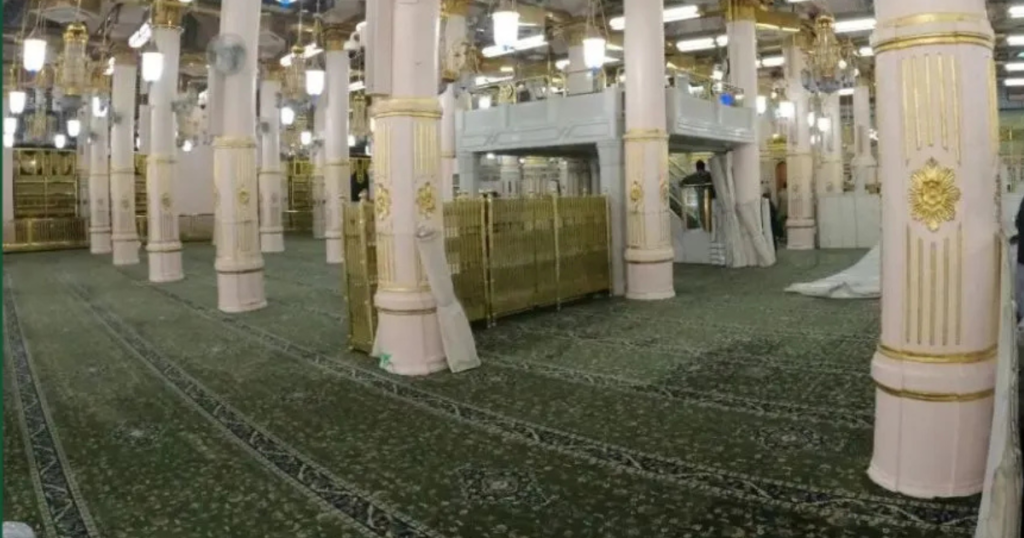
The Complete Preparation Checklist
Full spiritual preparation — from home to green carpet
- Weeks before: daily salawat increase, dua list begun, learn about the Rawdah, increase istighfar
- Night before: finalise dua list, screenshot permit, check gate number, set niyyah clearly
- Morning of: fresh wudhu at hotel, modest dress on, phone on silent, dua list accessible
- Walk to mosque: continuous salawat, no phone distractions, deliberate pace
- Entering mosque: recite the mosque entrance dua (Allāhumma aftaḥ lī abwāba raḥmatik)
- Walking to Rawdah: slow, lowered gaze, continuing salawat, building presence
- At the threshold: pause, breathe, let heart settle — then step
📎 Full guide: Duas & Spiritual Guide — Complete Arabic duas with transliteration →https://rawdahmadinah.com/crying-rawdah-madina-islam/
Full duas in Arabic, transliteration and English — including Sayyidul Istighfar, Durood Ibrahim, and duas for parents, health, rizq and Jannah