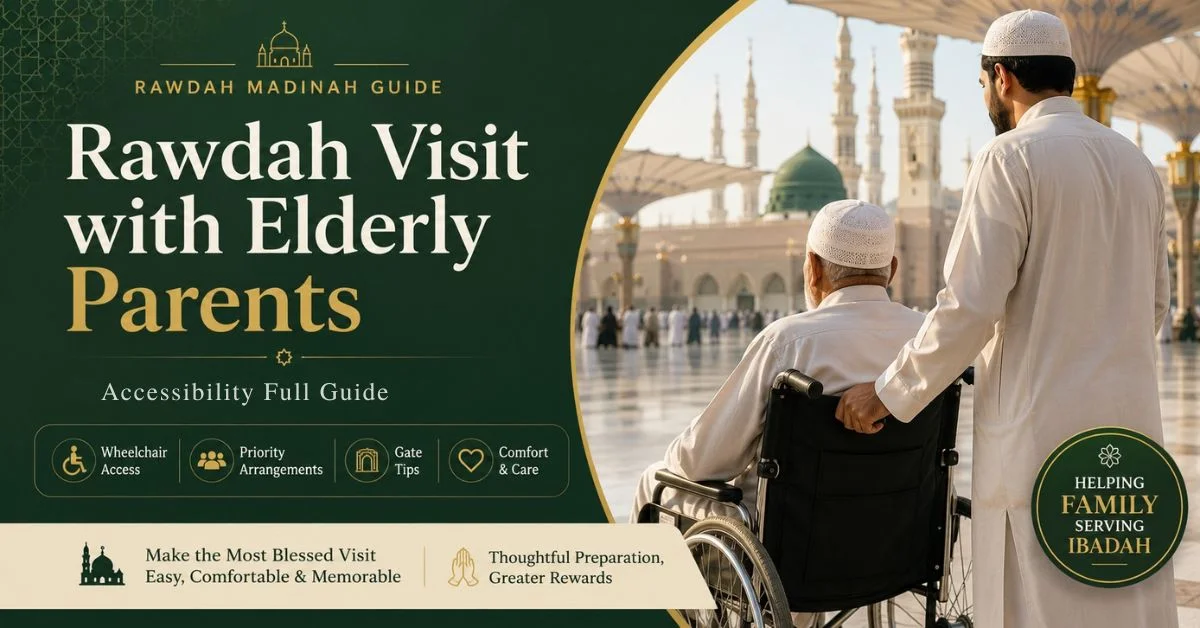
Taking elderly parents to the Rawdah is one of the most profound gifts a child can give. Many pilgrims describe it as the single most emotional experience of their Umrah or Hajj journey — watching a parent stand on the green carpet of Riyazul Jannah, making dua with tears streaming. But getting an elderly parent there comfortably requires specific planning. Hajj Reporters confirmed directly from Saudi authorities: “Elderly visitors are permitted to enter using a manual wheelchair.” The provisions are there — you just need to know how to use them.
Key Takeaways — Elderly Accessibility
What Saudi Authorities Have Confirmed for Elderly Pilgrims
The General Authority for the Affairs of the Two Holy Mosques has explicitly included provisions for elderly and mobility-limited pilgrims. Hajj Reporters reported the official position: manual wheelchair users are permitted to enter the Rawdah. Majmua.us further advises that “old pilgrims or those with health impairments are advised to rest before and, if possible, use mobility aids.”
Saudi Arabia’s Vision 2030 accessibility initiatives have significantly improved Masjid Nabawi’s provisions for pilgrims with mobility needs. The mosque has flat flooring throughout, wide corridors, and dedicated accessibility routes from multiple gates. You don’t need to manage this alone — the infrastructure is there.
“Your Lord has decreed that you worship none but Him, and that you be kind to your parents. Whether one or both of them reach old age with you, say no word of contempt to them.”
— Quran 17:23. Taking your elderly parent to Riyazul Jannah is among the highest expressions of this verse.
Planning the Permit for an Elderly Parent
Each person needs their own permit — including your elderly parent. Book on the Nusuk app using their passport number. KSA Expats confirms the standard booking process applies to all visitors regardless of age or mobility status.
Permit booking checklist for elderly visitors
- Download Nusuk app and create account using parent’s passport number and visa details
- Book the same date and time slot for all family members — coordinate permits together
- Choose the post-Fajr slot on a weekday for the least crowded and physically easiest experience
- Save QR code screenshots for every family member separately
- Check that the gate number on the permit is accessible — Gate 37 has multiple access routes
- Book at least 24 hours in advance — earlier during peak seasons
Full permit booking guide → Rawdah Permit Complete Booking Guide — Nusuk & Tawakalna
Getting an Elderly Parent to the Mosque Comfortably
Hotel selection — the most important decision
For elderly pilgrims, staying within walking distance of Masjid Nabawi is not a preference — it’s a necessity. RoamSaudi specifically advises staying nearby to “avoid transportation hassles.” Every taxi or bus journey for an elderly parent is physical energy that could have been spent inside the mosque.
The hotels on Al-Salam Street and around the mosque perimeter are 5–15 minutes walking distance. Spending more on accommodation to stay close is one of the best investments in an elderly parent’s experience.
Getting to the gate
Masjid Nabawi’s immediate surroundings have marble courtyards that are flat but can be very hot underfoot. Early morning visits significantly reduce this. The route from nearby hotels to Gate 37 is well-signposted and manageable even for slow walkers. If a wheelchair is needed, the mosque provides manual wheelchairs at major entrance points.
Practical Insight
When you arrive at the gate with an elderly or mobility-limited parent, do not join the standard queue first. Approach a security guard directly, show both permits, and explain that your parent has mobility needs. Guards are specifically trained to accommodate this and can direct you to an accessible entry route that bypasses the main pedestrian queue.
Inside the Mosque — Getting to the Rawdah
Masjid Nabawi’s interior is entirely flat-floored. The transition from the main mosque carpet to the green Rawdah carpet involves no steps. Wheelchair users can access the Rawdah area directly. Guards inside the mosque will guide you to the Rawdah entry point — the journey from the main gate to the Rawdah is approximately 5–10 minutes walking at a gentle pace.
Inside the mosque — what to know for elderly parents
- The Rawdah floor is flat — no steps, ramps or obstacles for wheelchair users
- Wheelchairs can enter the Rawdah directly alongside the permit holder
- Guards inside are experienced with elderly pilgrims and will assist patiently
- If your parent needs to sit rather than stand during dua — this is perfectly acceptable
- The 10-minute limit applies — focus on the most important duas during this time
- After leaving the Rawdah, the salaam area near the Noble Chamber has seating nearby
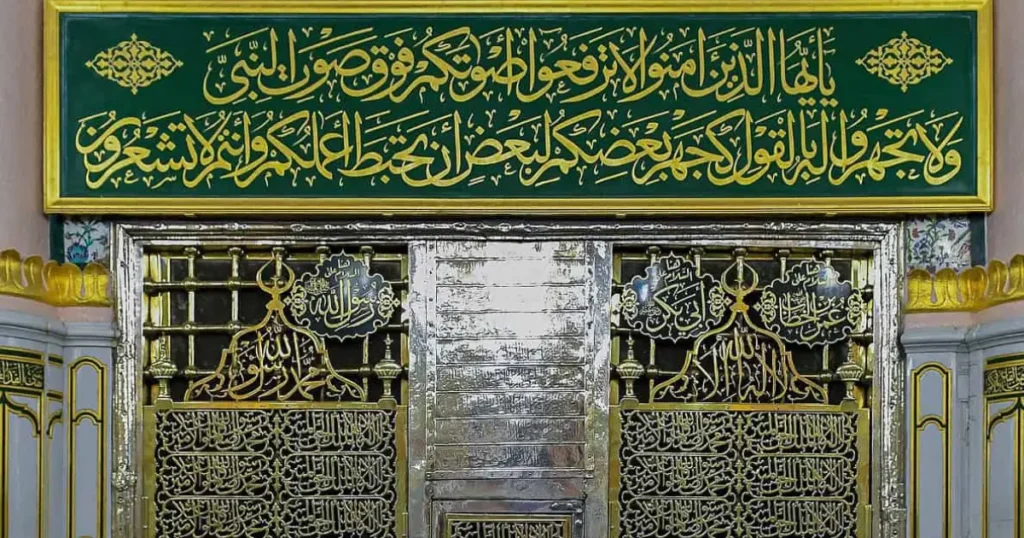
Making the Duas Count — Preparing Your Parent
The most important thing you can do for an elderly parent’s Rawdah visit is prepare their duas with them before arriving. At their age, many parents carry the weight of decades — health concerns, children’s futures, deceased loved ones, regrets, hopes. Sitting with them the evening before and writing their dua list together is an act of love as profound as taking them there.
📎 Get printable dua cards and give your parents to recite for you at Rawdah → Duas for the Rawdah Complete Collection
Full duas in Arabic, transliteration and English — including Sayyidul Istighfar, Durood Ibrahim, and duas for parents, health, rizq and Jannah
Emotional Preparation — For You as Much as for Them
If you’re taking a parent to the Rawdah, prepare yourself too. Watching a parent step onto the green carpet — a person who raised you, sacrificed for you, made dua for you for decades — and seeing them weep in that space, is one of the most emotionally overwhelming experiences a human being can have. Many children who have done this describe it as the moment their own faith deepened most profoundly.
Be present for them entirely. Don’t take photos. Don’t manage logistics in your head. Just be there with them, making dua alongside them, on the ground that the Prophet ﷺ described as a garden of Paradise.
📎 Help your parent prepare their duas — including duas for deceased loved ones and health → Duas & Spiritual Guide — What to Pray in the Rawdah
Full duas in Arabic, transliteration and English — including Sayyidul Istighfar, Durood Ibrahim, and duas for parents, health, rizq and Jannah