📖 Dua Hub
Explore 100+ authentic duas with translations, references, and free printable PDFs.
🎨 Dua Card Builder
Create Black & White personalised Islamic dua cards to download, print, or share online for free.
What this guide covers
Related pages on this site
- If you have not yet booked your Rawdah permit, read our complete guide first: Rawdah Permit — Complete Booking Guide (Nusuk & Tawakalna)
- Need a dua for a different situation?
Our comprehensive Rawdah Duas Hub organizes authentic Islamic supplications into easy-to-find categories. Whether you’re making dua for your mother, father, deceased parents, marriage, children, family, health, forgiveness, rizq, protection, or guidance, you’ll find dedicated articles with authentic references, Arabic text, transliteration, English translation, and Urdu.
Visit the hub to discover the complete collection and prepare the right duas before your visit to the blessed Rawdah.
Why the Rawdah is the Most Blessed Place to Make Dua
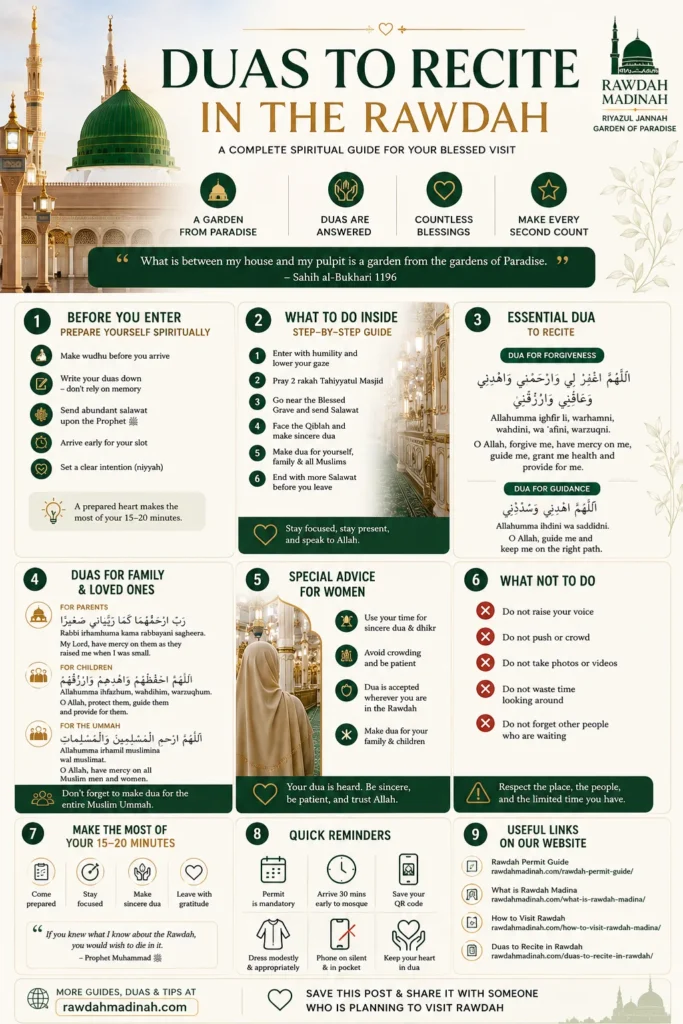
Before you enter the Rawdah, it is important to understand why this specific space carries such profound spiritual weight. This understanding will transform your visit from a physical experience into a deeply spiritual one.
“What is between my house and my pulpit is a garden from the gardens of Paradise, and my pulpit is upon my fountain (Hawd).”
— Sahih al-Bukhari, Hadith 1196 — narrated by Abu Hurairah (RA)
This hadith is the foundation of everything. The Prophet Muhammad ﷺ himself described this area as a garden — Riyazul Jannah — from the gardens of Paradise. Scholars of Islam have understood this in two ways: either the physical space will be transported to Paradise on the Day of Judgement, or that praying here carries the spiritual weight and reward equivalent to praying in a garden of Paradise.
Either interpretation points to the same truth — this is not ordinary ground. When you stand on that green carpet, you are standing in a space the Prophet ﷺ himself identified as sacred, between his home and his pulpit, where he led prayer, received revelation, and taught his companions.
“Make dua with certainty that Allah will answer, and know that Allah does not answer the dua of a heart that is heedless and distracted.”
— Tirmidhi, Hadith 3479
This is why preparation matters so much. You may only have 15 to 20 minutes inside. A heart that has prepared — that arrives with a list of sincere duas, in a state of wudhu, focused and present — will leave with far more than a heart that arrived unprepared and spent the time looking around.
How to Prepare Yourself Before Entering the Rawdah
Most pilgrims focus entirely on getting the permit and arriving on time. Very few focus on what happens before they step onto the green carpet. This preparation is what separates a visit that changes your life from one you barely remember.
1. Make wudhu (ablution) before you arrive
Do not leave wudhu until you reach the mosque. Make it at your hotel or at the ablution facilities before joining the queue. You want to arrive at the gate calm, spiritually ready, and not rushed. Arriving in a state of taharah (purification) is the foundation of everything that follows.
2. Write your duas down — do not rely on memory
This is the single most important piece of advice in this guide. When you step inside the Rawdah and the reality of where you are hits you, emotions will overwhelm you. Pilgrims who have visited dozens of times report that they still feel overwhelmed. If you rely on memory alone, you will forget half of what you wanted to ask for.
Write your duas in a small notebook or in your phone notes. Organise them into categories: yourself, your parents, your children, your health, your rizq (provision), your guidance, your akhirah (hereafter). When you are inside, you simply open your list and make dua from the heart.
3. Send Salawat abundantly before entering
As you walk through Masjid Nabawi towards the Rawdah, fill your tongue with salawat upon the Prophet ﷺ. This is both an act of worship and a spiritual preparation. The Prophet ﷺ said that whoever sends one salawat upon him, Allah sends ten mercies upon that person. Begin your visit in a state of mercy.
4. Arrive early for your slot
Arrive at least 10 to 15 minutes before your allocated time. This gives you time to calm yourself, find the correct gate, and enter in a composed state. Rushing to the gate at the last minute means you enter the Rawdah with a scattered mind.
5. Set your intention (Niyyah)
Make a clear intention before you enter. Why are you here? What are you asking for? Who are you making dua for? A clear niyyah focuses the heart and makes dua more sincere. You can say internally: ‘I am entering the Rawdah of the Prophet ﷺ to pray two rakah, send salawat, and make sincere dua for myself, my family, and all Muslims.’
Prepare this before your visit day
- Written dua list — organised by category (yourself, parents, children, health, rizq, akhirah)
- Wudhu made fresh — do not delay it until you reach the mosque
- Phone on silent and notifications off before entering Masjid Nabawi
- Memorise the entry gate number from your permit — Gate 37 (men) or Gate 25 (women)
- Comfortable modest clothing — you may be standing or sitting on the carpet for 15–20 minutes
Step-by-Step: What to Do Inside the Rawdah
When you enter, a lady guard will guide you to the green-carpeted area of the Rawdah. You will have approximately 15 to 20 minutes. Here is the complete sequence:
Step 1 — Step onto the green carpet
Step onto the green carpet and pause for a moment. Lower your gaze. Acknowledge where you are. Let the reality of this blessed space settle in your heart before you do anything else.
Step 2 — Send Salawat
Send Salawat upon the Prophet ﷺ immediately. Begin with Durood Ibrahim (the salawat recited in prayer). This is the opening of everything you will do here
Step 3 — Pray two rakah of nafl
Pray two rakah of nafl (voluntary) prayer if there is space to do so. The reward for nafl prayer inside Riyazul Jannah is immeasurable. If space does not allow, move to step 4.
Step 4 — Open your dua list.
Open your dua list. Begin making dua sincerely and from the heart. Raise your hands. Speak to Allah directly in any language — Arabic, Urdu, English, whatever comes from the heart most naturally.
Step 5 — Work through your categories
Work through your categories: yourself first, then parents, then children, then extended family, then all Muslims. Do not rush. Speak each dua slowly and with certainty that it will be answered.
Step 6 — Close with salawat
Close with salawat upon the Prophet ﷺ again. End as you began — with praise and blessings upon him in whose presence you are standing.
Step 7 — Your time is ending
When the lady guard signals your time is ending, leave calmly and with gratitude. Do not feel rushed or upset. You have been in one of the most blessed spots on earth.
How long does each part take?
- Pause and acknowledgement — 30 seconds to 1 minute
- Opening salawat — 1 to 2 minutes
- Two rakah nafl prayer — 3 to 5 minutes
- Personal duas from your list — 8 to 12 minutes
- Closing salawat — 1 minute
- Total: fits comfortably within 15 to 20 minutes if you are prepared
Salawat Upon the Prophet ﷺ — What to Recite
Salawat (sending blessings and peace upon the Prophet ﷺ) is the most appropriate act to perform inside the Rawdah. You are standing between his home and his pulpit — sending salawat here carries extraordinary weight.
Durood Ibrahim — The Salawat of Prayer
This is the salawat recited in every salah. Begin with this:
اللَّهُمَّ صَلِّ عَلَى مُحَمَّدٍ وَعَلَى آلِ مُحَمَّدٍ، كَمَا صَلَّيْتَ عَلَى إِبْرَاهِيمَ وَعَلَى آلِ إِبْرَاهِيمَ، إِنَّكَ حَمِيدٌ مَجِيدٌ. اللَّهُمَّ بَارِكْ عَلَى مُحَمَّدٍ وَعَلَى آلِ مُحَمَّدٍ، كَمَا بَارَكْتَ عَلَى إِبْرَاهِيمَ وَعَلَى آلِ إِبْرَاهِيمَ، إِنَّكَ حَمِيدٌ مَجِيدٌ
Allahumma salli ‘ala Muhammadin wa ‘ala aali Muhammad, kama sallayta ‘ala Ibrahima wa ‘ala aali Ibrahim, innaka Hameedun Majeed. Allahumma barik ‘ala Muhammadin wa ‘ala aali Muhammad, kama barakta ‘ala Ibrahima wa ‘ala aali Ibrahim, innaka Hameedun Majeed.
“O Allah, send Your mercy upon Muhammad and upon the family of Muhammad, as You sent Your mercy upon Ibrahim and upon the family of Ibrahim. Truly You are Praiseworthy and Glorious. O Allah, send Your blessings upon Muhammad and upon the family of Muhammad, as You sent Your blessings upon Ibrahim and upon the family of Ibrahim. Truly You are Praiseworthy and Glorious.”
— Sahih al-Bukhari
Short Salawat — Repeat Abundantly
Between your duas, fill any pauses with this short form of salawat:
صَلَّى اللهُ عَلَيْهِ وَسَلَّمَ
Sallallahu ‘alayhi wa sallam
“May Allah’s peace and blessings be upon him”
— Sahih al-Bukhari
“Whoever sends one salawat upon me, Allah will send ten mercies upon him, erase ten of his sins, and raise him ten degrees.”
— Sunan al-Nasa’i, Hadith 1297
Complete Duas to Recite Inside the Rawdah
These are the most important duas to make inside the Rawdah. They are drawn from the Quran and authentic Sunnah — the most powerful words you can bring before Allah in this blessed space. All duas are given in Arabic, transliteration, and English translation. You can also visit
Dua for Forgiveness — The Master Supplication
Begin with seeking forgiveness. This is Sayyidul Istighfar — the Master of all istighfar supplications, as described by the Prophet ﷺ:
اللَّهُمَّ أَنْتَ رَبِّي لَا إِلَهَ إِلَّا أَنْتَ، خَلَقْتَنِي وَأَنَا عَبْدُكَ، وَأَنَا عَلَى عَهْدِكَ وَوَعْدِكَ مَا اسْتَطَعْتُ، أَعُوذُ بِكَ مِنْ شَرِّ مَا صَنَعْتُ، أَبُوءُ لَكَ بِنِعْمَتِكَ عَلَيَّ وَأَبُوءُ لَكَ بِذَنْبِي فَاغْفِرْ لِي فَإِنَّهُ لَا يَغْفِرُ الذُّنُوبَ إِلَّا أَنْتَ
Allahumma anta Rabbi la ilaha illa anta, khalaqtani wa ana abduka, wa ana ‘ala ‘ahdika wa wa’dika mastata’tu, a’udhu bika min sharri ma sana’tu, abu’u laka bi ni’matika ‘alayya wa abu’u laka bi dhanbi faghfir li fa innahu la yaghfirudh-dhunuba illa ant.
“O Allah, You are my Lord, there is no god but You. You created me and I am Your servant, and I am keeping my covenant and promise to You as best I can. I seek refuge in You from the evil of what I have done. I acknowledge Your blessing upon me and I acknowledge my sin — so forgive me, for there is none who forgives sins except You.”
— Sahih al-Bukhari, Hadith 6306
Dua for This World and the Next — The Complete Supplication
This dua, frequently recited by the Prophet ﷺ, covers everything a believer needs in this life and the hereafter:
رَبَّنَا آتِنَا فِي الدُّنْيَا حَسَنَةً وَفِي الْآخِرَةِ حَسَنَةً وَقِنَا عَذَابَ النَّارِ
Rabbana atina fid-dunya hasanatan wa fil-akhirati hasanatan wa qina ‘adhab an-nar.
“Our Lord, give us good in this world and good in the Hereafter, and protect us from the punishment of the Fire.”
— Quran 2:201 — Sahih al-Bukhari, Hadith 4522
Dua for Guidance on the Straight Path
Very powerful dua that we recite in our every prayer daily.
اهْدِنَا الصِّرَاطَ الْمُسْتَقِيمَ
Ihdinas-siratal mustaqeem.
“Guide us to the straight path.”
— Quran 1:6 — recite this with the full awareness of where you are standing
Dua for Parents(Father and Mother)
One of the most beloved things you can do in the Rawdah is make dua for your parents — living or deceased. This act is among the highest forms of honour and gratitude:
رَبِّ اغْفِرْ لِي وَلِوَالِدَيَّ وَارْحَمْهُمَا كَمَا رَبَّيَانِي صَغِيرًا
Rabbighfir li wa li-walidayya warhamhuma kama rabbayani sagheera.
“My Lord, forgive me and my parents, and have mercy on them as they raised me when I was small.”
— Quran 17:24
Dua for Health and Wellbeing — Dua of Ayyub (AS)
رَبِّ إِنِّي مَسَّنِيَ الضُّرُّ وَأَنْتَ أَرْحَمُ الرَّاحِمِينَ
Rabbi inni massaniyad-durru wa anta arhamur-rahimeen.
“My Lord, indeed adversity has touched me, and You are the Most Merciful of the merciful.”
— Quran 21:83 — the prayer of Prophet Ayyub (AS) in his greatest trial
Dua for Provision and Sustenance (Rizq)
اللَّهُمَّ اكْفِنِي بِحَلَالِكَ عَنْ حَرَامِكَ وَأَغْنِنِي بِفَضْلِكَ عَمَّنْ سِوَاكَ
Allahummak-fini bi-halalika ‘an haramika wa aghnini bi-fadlika ‘amman siwak.
“O Allah, suffice me with what You have made lawful so that I have no need for what You have made unlawful, and enrich me by Your grace so that I have no need of anyone other than You.”
— Tirmidhi, Hadith 3563 — classified as Hasan
Dua for a Righteous Spouse and Children
رَبَّنَا هَبْ لَنَا مِنْ أَزْوَاجِنَا وَذُرِّيَّاتِنَا قُرَّةَ أَعْيُنٍ وَاجْعَلْنَا لِلْمُتَّقِينَ إِمَامًا
Rabbana hab lana min azwajina wa dhurriyyatina qurrata a’yunin waj’alna lil-muttaqina imama.
“Our Lord, grant us from among our spouses and offspring comfort to our eyes and make us a leader for the righteous.”
— Quran 25:74
Dua for Protection from All Haram — Morning and Evening Remembrance
بِسْمِ اللَّهِ الَّذِي لَا يَضُرُّ مَعَ اسْمِهِ شَيْءٌ فِي الْأَرْضِ وَلَا فِي السَّمَاءِ وَهُوَ السَّمِيعُ الْعَلِيمُ
Bismillahil-ladhi la yadurru ma’asmihi shay’un fil-ardi wa la fis-sama’i wa huwa-s-sami’ul-‘aleem.
“In the name of Allah, with whose name nothing on earth or in heaven can cause harm, and He is the All-Hearing, All-Knowing.”
— Abu Dawud, Hadith 5088 — recited 3 times
Dua for Entry into Paradise — Dua of the Prophet ﷺ
اللَّهُمَّ إِنِّي أَسْأَلُكَ الْجَنَّةَ وَأَعُوذُ بِكَ مِنَ النَّارِ
Allahumma inni as’alukal-jannata wa a’udhu bika minan-nar.
“O Allah, I ask You for Paradise and I seek refuge in You from the Fire.”
— Abu Dawud, Hadith 792
Special Duas for Specific Needs
If you are in debt or financial difficulty
اللَّهُمَّ إِنِّي أَعُوذُ بِكَ مِنَ الْهَمِّ وَالْحَزَنِ، وَأَعُوذُ بِكَ مِنَ الْعَجْزِ وَالْكَسَلِ، وَأَعُوذُ بِكَ مِنَ الْجُبْنِ وَالْبُخْلِ، وَأَعُوذُ بِكَ مِنْ غَلَبَةِ الدَّيْنِ وَقَهْرِ الرِّجَالِ
Allahumma inni a’udhu bika minal-hammi wal-hazan, wa a’udhu bika minal-‘ajzi wal-kasal, wa a’udhu bika minal-jubni wal-bukhl, wa a’udhu bika min ghalabatid-dayni wa qahrir-rijal.
“O Allah, I seek refuge in You from worry and grief, from weakness and laziness, from cowardice and miserliness, and from the burden of debt and the oppression of men.”
— Sahih al-Bukhari, Hadith 2893
If you are seeking a child
رَبِّ لَا تَذَرْنِي فَرْدًا وَأَنْتَ خَيْرُ الْوَارِثِينَ
Rabbi la tadhharni fardan wa anta khayrul-waritheen.
“My Lord, do not leave me childless, though You are the best of inheritors.”
— Quran 21:89 — the dua of Prophet Zakariyya (AS)
If you are grieving or going through hardship
حَسْبُنَا اللَّهُ وَنِعْمَ الْوَكِيلُ
Hasbunallahu wa ni’mal-wakeel.
“Allah is sufficient for us, and He is the best Disposer of affairs.”
— Quran 3:173 — recited by Ibrahim (AS) when thrown into the fire
Dua for deceased parents and loved ones
One of the most powerful things you can do in the Rawdah is make dua for those who have passed. Recite Surah al-Fatiha and dedicate its reward to them, then say:
اللَّهُمَّ اغْفِرْ لَهُمْ وَارْحَمْهُمْ وَعَافِهِمْ وَاعْفُ عَنْهُمْ
Allahummaghfir lahum warhamhum wa ‘afihim wa’fu ‘anhum.
“O Allah, forgive them, have mercy on them, grant them wellbeing, and pardon them.”
— Muslim, Hadith 963
Special note for women visiting the Rawdah
- Women often have shorter visiting windows and sometimes more limited space. Prepare your duas even more carefully.
- The duas in this guide are for all Muslims equally — there is no distinction in what women can ask for.
- If you find yourself emotional inside the Rawdah, do not suppress it. Many of the greatest duas in history were made through tears.
- Recite your duas quietly — even a whisper in your heart is heard by Allah.
- If you were unable to pray two rakah due to space or time, simply make dua from where you stand — this is equally accepted.
What Not to Do Inside the Rawdah
These are the most common mistakes pilgrims make — understanding them beforehand will help you avoid them and protect the quality and sincerity of your visit:
- Taking photos or videos — this is not prohibited inside the Rawdah but will result in being asked to leave. Keep your phone in your pocket.
- Making dua loudly — this disturbs others and is contrary to the etiquette of the space. Keep your voice to a whisper or make silent dua in your heart.
- Rushing through duas without focus — 10-15 minutes of sincere, focused dua is worth infinitely more than 15 minutes of distracted, rushed supplication.
- Spending time looking around instead of making dua — you are not here as a tourist. Lower your gaze, focus on Allah, and use every second.
- Pushing or rushing other pilgrims — the guards will manage the flow. Trust the system and move calmly.
- Forgetting to make dua for others — many pilgrims only make dua for themselves. Making dua for your parents, children, and all Muslims is one of the highest acts here.
- Arriving without wudhu — while wudhu is not strictly required for dua, being in a state of purity is strongly recommended, especially for prayer.
- Leaving without sending final salawat — always close your visit by sending peace and blessings upon the Prophet ﷺ in whose blessed proximity you stand.
What to Do After Leaving the Rawdah
Your visit to the Rawdah does not end when you step off the green carpet. Here is how to carry the experience forward:
- Find a quiet corner of Masjid Nabawi and continue your duas. The spiritual state you leave the Rawdah in is precious — extend it as long as you can.
- Perform your next salah inside Masjid Nabawi. One prayer here is worth 1,000 prayers elsewhere (Sahih al-Bukhari, Hadith 1190).
- Visit the salaam area near the Prophet’s grave ﷺ and send your salutations if you have not done so. Say: ‘Assalamu alayka ya Rasulallah wa rahmatullahi wa barakatuh.’
- Make a commitment — write down one change you will make in your life as a result of this visit. A changed action is the truest sign of a dua made with sincerity.
- Share the duas from this guide with family and friends who are planning to visit — the reward for teaching goodness continues long after you have left.
“The best of deeds is to bring joy to the heart of a believer.”
— Al-Mu’jam al-Awsat, Al-Tabarani — sharing this guide is an act of bringing joy