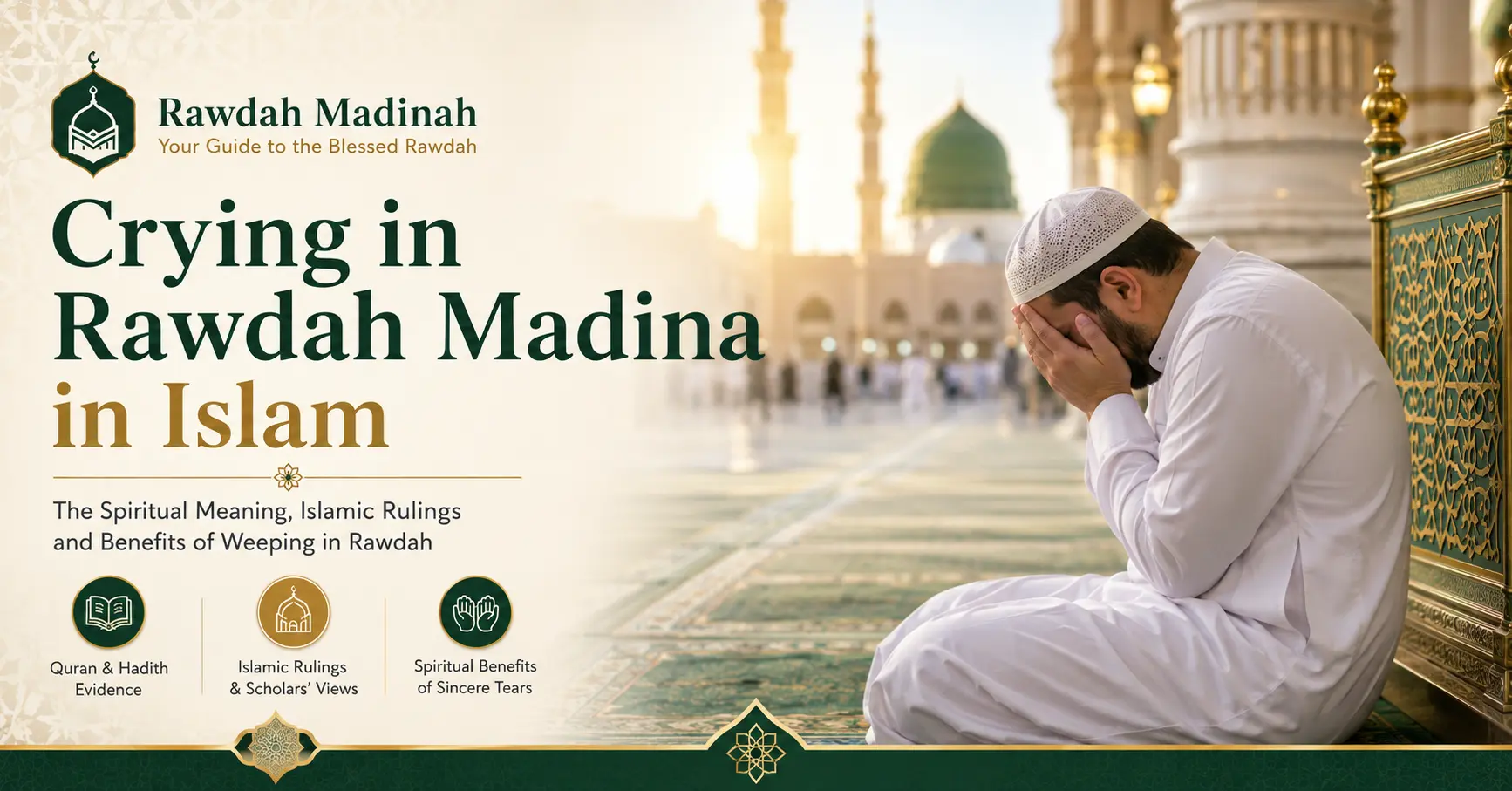
Almost every pilgrim who visits the Rawdah for the first time cries. Men who haven’t wept in decades find tears they didn’t know existed. Women describe being overwhelmed before they’ve even finished their first dua. Why does this happen — and what does Islam say it means?
The short answer: it means your heart is alive. About Islam states directly: “Crying while making dua is a sign of fearing Allah. Scholars maintain that crying during prayer or when you make dua purifies your heart and brings you closer to Allah.” Your tears in the Rawdah aren’t a loss of composure. They’re one of the most valued responses a human heart can have to standing in the presence of the sacred.
Key Takeaways
What Does Islam Say About Crying Before Allah?
The Quran and Sunnah are both unambiguous — tears shed out of love, fear, and longing for Allah are among the most valued responses a believer can have.
“There are seven whom Allah will shade in His Shade on the Day when there is no shade except His Shade — one of them is a man who remembers Allah in private and his eyes shed tears.”
— Sahih al-Bukhari, Hadith 660. Standing alone in the Rawdah and weeping while remembering Allah places you in this category.
This hadith is one of the most cited in Islamic spirituality — and its implications for the Rawdah are profound. The green carpet is not a public display. You are as private there as in your own room, despite the people around you. Your tears, whispered into your own hands, are between you and Allah. That is exactly the scenario the hadith describes.
Al-Islam.org explored this at length in their 2025 series on grief in Islam: “Islam as the religion of nature (fitrah) embraces human emotions — the Prophet Muhammad ﷺ himself wept for loved ones, including his son Ibrahim and his uncle Hamza.” If the Prophet ﷺ wept, crying is not weakness. It’s the most human, most authentic response to love.
Why the Rawdah Specifically Produces Tears
It’s not just any location that produces this response. The Rawdah carries specific properties — physical, historical, and spiritual — that converge to make emotional overwhelm almost inevitable for a prepared heart.
You’re standing where the Prophet ﷺ stood
The Rawdah is the space between the Prophet’s home and his pulpit. He prayed here. He taught here. He received companions here. He laughed and wept here. Hajj Safe captures it: “When you enter the Rawdah, don’t rush. Take a deep breath. Let your heart settle. Many righteous people have prayed here over the centuries.” The weight of that history hits the heart before the mind can process it.
The ground is described as Paradise itself
The Prophet ﷺ said this specific area is a garden from the gardens of Jannah. You aren’t standing in a beautiful building — you are standing in what will become Paradise. The soul recognises what the mind is still catching up to. Prayertimesksa.com notes: “Every act of worship done here is magnified — dua, dhikr, Quran recitation, or salawat.” The heart feels the weight of that multiplication.
You’ve carried your duas here from home
Most pilgrims carry years of unexpressed longing into the Rawdah — for a sick parent, a struggling child, a marriage that needs saving, sins that need forgiving, a relationship with Allah that needs rebuilding. When the body finally arrives at the place the heart has been yearning to reach, the release is physical. Tears are the body’s response to emotional arrival.
Original Insight
Pilgrims who prepare their duas most thoroughly often cry the most — not because they’re overwhelmed with logistics, but because they arrive knowing exactly what they’re asking for. Preparation creates presence. Presence creates tears. This is why writing your duas before entering is spiritual preparation, not just practical planning.
📎 Full guide: Duas & Spiritual Guide — Complete Arabic duas with transliteration →https://rawdahmadinah.com/spiritual-preparation-rawdah-visit/
Full duas in Arabic, transliteration and English — including Sayyidul Istighfar, Durood Ibrahim, and duas for parents, health, rizq and Jannah
What the Prophet ﷺ Said About Tears in Dua
“Nothing is dearer to Allah than a teardrop shed out of fear of Him, or a drop of blood spilled for His sake.”
— Sahih al-Tirmidhi. Cited at Harvard’s GenEd 1134 course on Islamic spirituality (2024).
Ahlul Bait Foundation of South Africa — in their commentary on the sacred value of tears — recorded: “Imam Ali (AS) says that crying out of fear of Allah enlightens the heart and protects the heart from repetition of sins.” The tear is not just emotionally releasing — it spiritually changes the heart that produces it.
About Islam adds the scholarly consensus: “Crying while reading the Quran, during prayer or while making dua is one of the characteristics of the righteous people.” Not just acceptable — characteristic. It marks you as someone whose worship is genuine.
📎 Full guide: Duas & Spiritual Guide — Complete Arabic duas with transliteration →https://rawdahmadinah.com/how-to-visit-rawdah-madina/
Full duas in Arabic, transliteration and English — including Sayyidul Istighfar, Durood Ibrahim, and duas for parents, health, rizq and Jannah
What to Do When You Start Crying Inside the Rawdah
Many first-time visitors worry that tears will disrupt their duas — that they’ll spend their 10 minutes sobbing rather than supplicating. IslamQA offers the scholarly balance: “The heart may be humbly submissive without there being tears in the eyes, or there may be tears in the eyes. What matters is the humble submission of the heart.”
In practice: let the tears come. Don’t suppress them. Don’t wipe them away hurriedly and try to regain composure. Let them flow while your lips continue making dua. Whispered prayers said through tears carry a quality that composed recitation rarely reaches.
When tears come — what to do
- Don’t suppress — tears are not a sign your visit is going wrong, they’re a sign it’s going right
- Continue making dua quietly — whisper through the tears, your words are still heard
- If words fail — raise your hands and let your heart speak. “Ya Allah” alone, said from a broken place, is a complete dua.
- Don’t look around — maintain your direction (qibla for dua) and your inner focus
- When the guard signals time — move calmly. Don’t rush to “compose yourself” for others. Leave as you are.
- After leaving — find a quiet spot in Masjid Nabawi. Let the state settle before re-entering the world.
📎 Full guide: Duas & Spiritual Guide — Complete Arabic duas with transliteration →https://rawdahmadinah.com/what-is-rawdah-madina/
Full duas in Arabic, transliteration and English — including Sayyidul Istighfar, Durood Ibrahim, and duas for parents, health, rizq and Jannah
What If You Don’t Cry — Does That Mean Something Is Wrong?
This is a question that troubles many pilgrims — especially men who feel they “should” cry but don’t. IslamQA answers directly: “The one who is not able to weep should not miss out on reflecting — the heart may be humbly submissive, without there being tears in the eyes.”
Not crying in the Rawdah doesn’t mean your visit was wasted or your dua wasn’t heard. It might mean you’re processing the experience differently. It might mean the tears will come later — in the mosque, in your hotel room, on the flight home. It might mean your worship in that moment was inwardly focused rather than outwardly expressed. All of these are valid. Allah sees what no eye detects.
“What is between my house and my pulpit“Make dua with certainty that Allah will answer, and know that Allah does not answer the dua of a heart that is heedless and distracted.” is a garden from the gardens of Paradise, and my pulpit is upon my fountain (Hawd).”
— Tirmidhi, Hadith 3479. The criterion is presence and sincerity — not tears.
📎 Full guide: Duas & Spiritual Guide — Complete Arabic duas with transliteration → rawdahmadinah.com/duas-to-recite-in-rawdah/
Full duas in Arabic, transliteration and English — including Sayyidul Istighfar, Durood Ibrahim, and duas for parents, health, rizq and Jannah
The Prophet ﷺ Wept — And So Can You
Al-Islam.org (April 2026) documented the Prophet’s ﷺ weeping in their Ramadan Reflections series: “The Prophet ﷺ himself wept for his son Ibrahim when he died, showing that expressing grief is not only natural but sometimes necessary in our faith journey.” Sahih al-Bukhari (Hadith 1303) records the Prophet ﷺ saying when his son died: “The eyes shed tears and the heart grieves, but we don’t say anything except what pleases our Lord.”
He wept. He permitted weeping. He said tears in worship are dear to Allah. There is nothing more the matter requires.