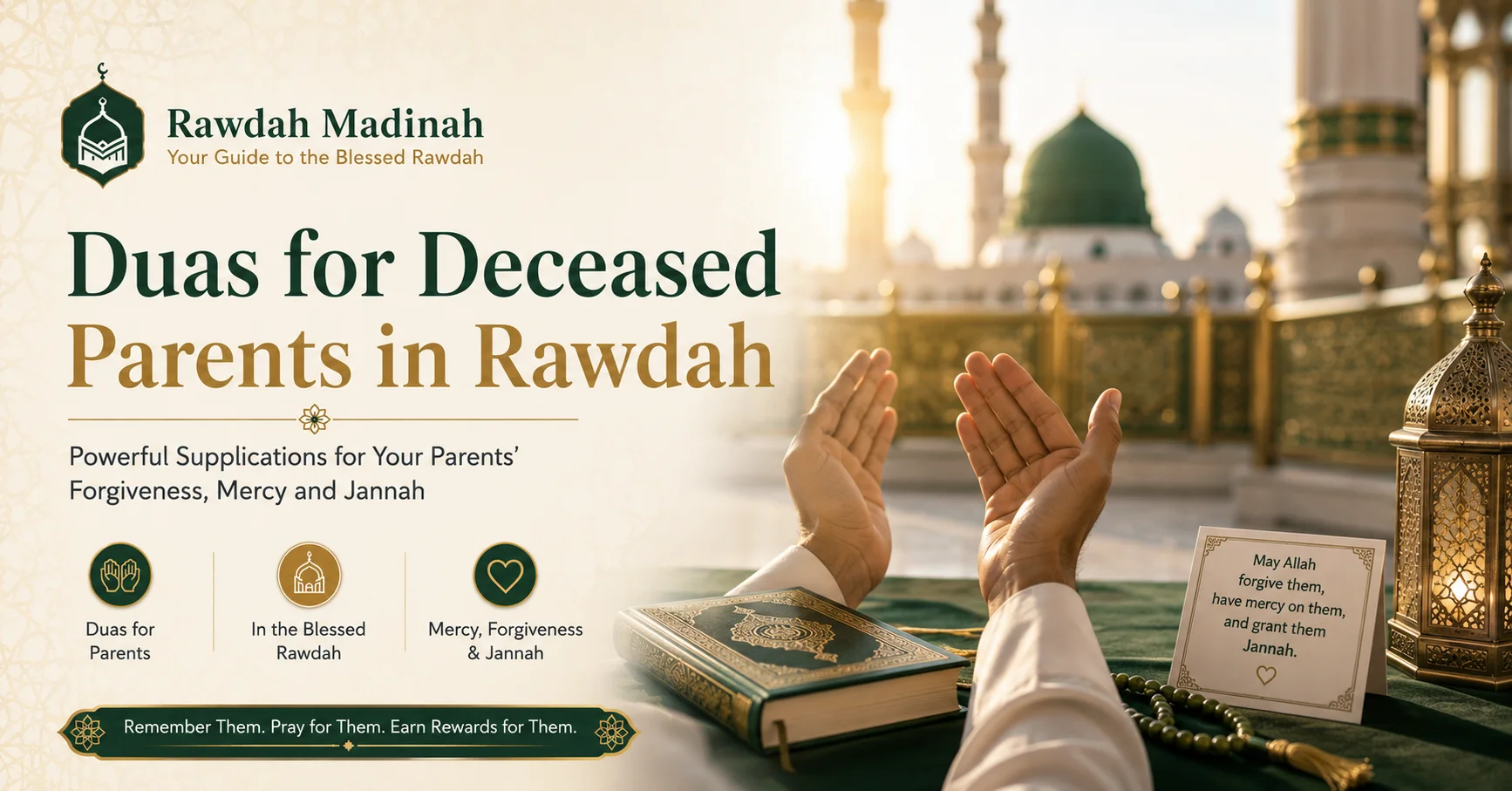
Standing in Riyazul Jannah — the Garden of Paradise — and making dua for a parent who has passed is one of the most profound acts a Muslim child can perform.
“Making dua for parents is not only an act of love and gratitude but also a source of profound spiritual blessings for both the supplicant and the parents.” The Rawdah amplifies that truth to its highest possible form.
This guide gives you everything — the Arabic duas with full transliteration and translation, the Islamic basis for why your supplication reaches your deceased parents, and how to use your precious 10 minutes inside the Rawdah to honour them completely.
Key Takeaways
Related pages on this site
- 📎 Haven’t booked your permit yet? → Rawdah Permit Complete Guide — Nusuk & Tawakalna Step by Step
Why Your Dua for Deceased Parents Reaches Them
The Islamic basis for making dua for deceased parents is unambiguous and deeply rooted in authentic hadith. Al-Dirassa (November 2025)
explains: “Offering supplications for deceased parents is an act of recognition and mercy within Islam — it allows believers to express gratitude towards their parents for their lifelong sacrifices while seeking Allah’s forgiveness and mercy for them.”
“When a person dies, his deeds come to an end except for three: Sadaqah Jariyah (ongoing charity), knowledge from which others benefit, or a righteous child who prays for him.”
— Sahih Muslim, Hadith 1631. Your dua for your deceased parent in the Rawdah falls directly under this hadith.
The connection is direct and confirmed. When you stand in the Garden of Paradise and call upon Allah for your mother or father, you are performing one of the three acts the Prophet ﷺ specifically identified as continuing to benefit a person after death. You aren’t remembering them — you’re actively sending them mercy.
Another dimension that matters deeply: “Making dua for parents opens pathways for divine blessings in your own life, as the Prophet ﷺ emphasised that pleasing and honoring one’s parents is closely linked to earning Allah’s pleasure.” The reward flows both ways.
The Complete Duas to Recite for Deceased Parents
These are the most authenticated and most powerful duas drawn from the Quran and Sunnah. Each is given in Arabic, transliteration, and English so you can choose the form most natural to your heart.
“When a person dies, his deeds come to an end except for three: Sadaqah Jariyah (ongoing charity), knowledge from which others benefit, or a righteous child who prays for him.”
— Sahih Muslim, Hadith 1631. Your dua for your deceased parent in the Rawdah falls directly under this hadith.
Dua 1 — The Quranic Foundation: Forgiveness and Mercy
This is the primary dua recommended by scholars specifically for deceased parents. It comes directly from the Quran and was taught by the Prophet ﷺ:
رَبِّ اغْفِرْ لِي وَلِوَالِدَيَّ وَارْحَمْهُمَا كَمَا ربيٰني صَغِيْرََا
Rabbighfir lī wa liwālidayya warḥamhumā kamā rabbayānī ṣaghīrā.
“My Lord, forgive me and my parents, and have mercy on them as they raised me when I was small.”
— Quran 17:24. Recite this first — it’s the most recommended dua for parents in all of Islamic scholarship.
Dua 2 — Comprehensive Mercy and Forgiveness
Here is another one of the most significant duas for the deceased — asking Allah for the full range of blessings in the afterlife:
اَللّٰهُمَّ غْفِرْ لَهُمْ وَارْحَمْهُمْ وَعَافِهِمْ وَاعْفُ عَنْهُمْ
Allāhummaghfir lahum warḥamhum wa ‘āfihim wa’fu ‘anhum.
“O Allah, forgive them, have mercy on them, grant them wellbeing, and pardon them.”
— Sahih Muslim, Hadith 963
Dua 3 — Light in the Grave
The Prophet ﷺ taught the companions to pray for the deceased’s resting place to be a source of peace. This dua asks for light and spaciousness in the grave:
اَللّٰهُمَّ نَوِّرْ قُبُورَهُمْ وَاجْعَلْهَا رَوْضَةً مِنْ رِيَاضِ الْجَنَّةِ
Allāhumma nawwir lahum qabraham waj’alhu rawdatan min riyāḍil jannati.
“O Allah, illuminate their grave and make it a garden from the gardens of Paradise.”
— Based on authentic prophetic guidance on dua for the deceased. Deeply moving to recite while standing in Riyazul Jannah itself.
Unique Insight
There is a profound resonance in standing in Riyazul Jannah — the Garden of Paradise — and asking Allah to make your parent’s grave a garden of Paradise too. You are asking from inside the very thing you’re asking for. Many pilgrims who have made this dua describe it as the most emotionally powerful moment of their Rawdah visit.
Dua 4 — Entry into Jannah
اَللّٰهُمَّ أَلْحِقْهُمْ بِالصَّالِحِينَ، وَأَدْخِلْهُمُ الْجَنَّةَ
Allāhumma alḥiqhum biṣṣāliḥīn wa adkhilhumul jannata.
“O Allah, join them with the righteous and enter them into Paradise.”
— Based on IQRA Network compilation of duas for the deceased
Dua 5 — Surah Al-Fatiha with Dedication
Before each dua, recite Surah Al-Fatiha once and dedicate its reward to your parents. Say before reciting: “Allāhumma abligh thawāba hādhihi al-Fātiḥati ilā rūḥi [name of parent].” — “O Allah, convey the reward of this Fatiha to the soul of [parent’s name].”
This practice is supported by the majority of Islamic scholars as a valid and beneficial act for deceased loved ones.
How to Structure Your 10 Minutes for Parents
Given that your visit is now 10 minutes, intentional sequencing matters. Here is an advise to pilgrims: “Make a separate list of the family and friends you want to pray for, including any specific requests or duas they have made.” For a visit dedicated to parents, here’s the optimal sequence:
10-minute sequence — visit dedicated to deceased parents
What to Do If You Can’t Recite Arabic
This is one of the most common concerns — and the answer is clear. “May every believer pray earnestly for their parents’ forgiveness and mercy, and may Allah answer their sincere supplications.”
Make dua in your language. Tell Allah about your mother — who she was, what she meant to you, what you’re asking for her. Tell Him about your father the same way. Allah hears every tongue and understands every heart. A dua made in Punjabi from a broken heart in Riyazul Jannah carries more weight than a perfectly pronounced Arabic dua recited without feeling.
Related pages on this site
- 📎 Complete duas guide — all in Arabic, transliteration and English → What to Pray in the Rawdah — Full Spiritual Guide
Making Dua on Behalf of Others — Family and Friends
Before entering the Rawdah, it’s common for family members at home to ask you to pray for them. Amaliah specifically addresses this: “Before you leave, many of your near and dear will ask you to make duas for them — the closest your family and friends will get to doing Hajj without going this year is through knowing you will pray for them.”
The Prophet ﷺ said that when you make dua for your brother in his absence, the angels say “and for you the same.” Every dua you make for another person in the Rawdah returns to you multiplied. Keep a short list: parents, siblings, spouse, children, anyone suffering from illness or hardship.
“When a Muslim makes dua for his brother in his absence, an angel says: ‘And for you the same.'”
— Sahih Muslim, Hadith 2732. Making dua for others in the Rawdah multiplies the reward for both.
After the Rawdah — Continue the Act of Honour
Sakeena Academy emphasises that dua for the deceased isn’t a one-time act: “Charity or Sadaqah for the dead, Quran recitation on their behalf, and sincere dua all help the deceased.” The Rawdah visit is a beginning, not a completion.
After returning home, establish a regular practice of reciting Surah Al-Fatiha for your parents after your daily prayers. Give charity in their names. These acts compound — the reward doesn’t stop at the green carpet.