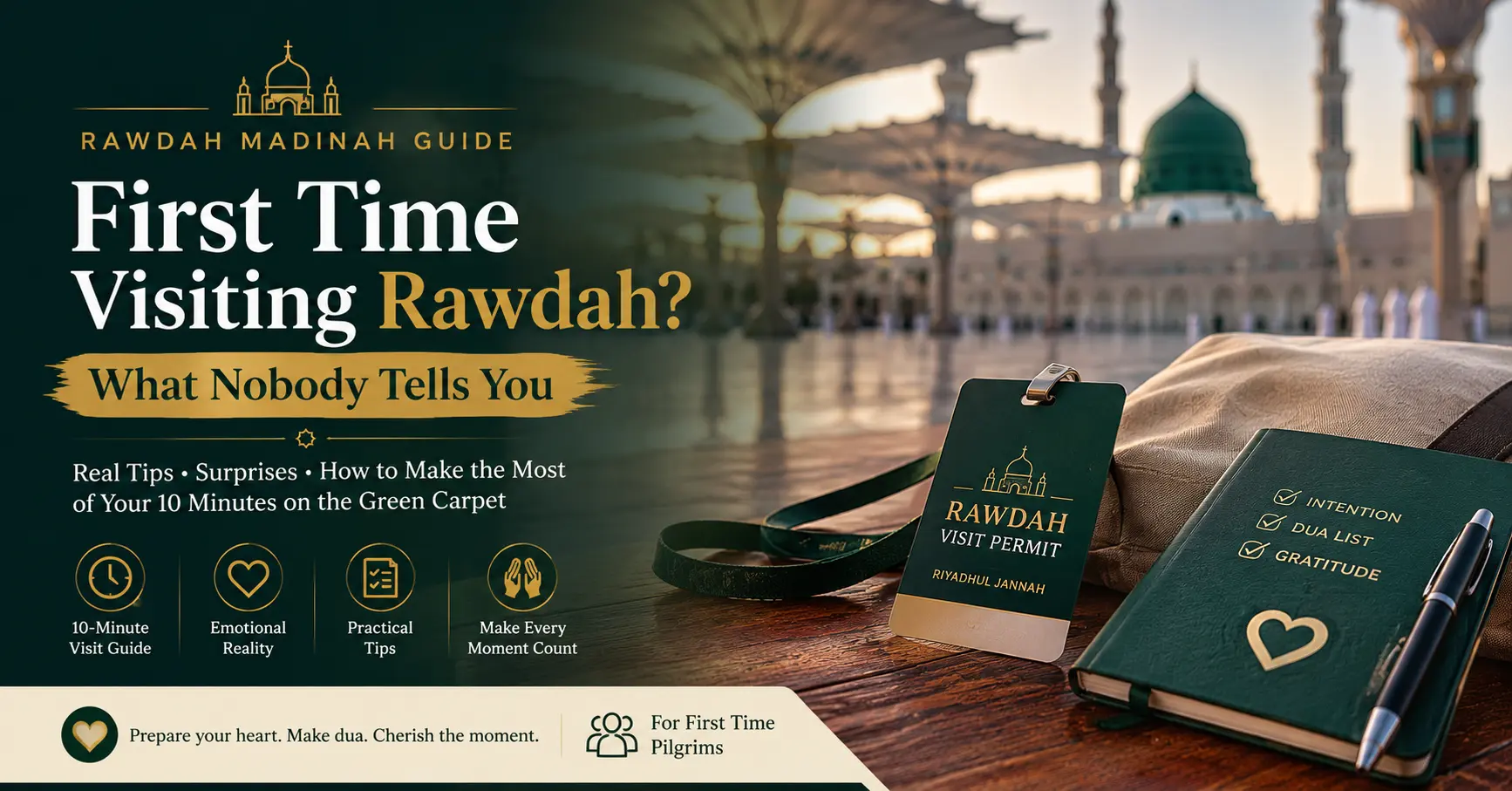
Every guide tells you what to do in the Rawdah. Very few tell you what it actually feels like to be there for the first time — and why that reality matters for how you prepare. A travel site captures it perfectly: “Visiting Rawdah begins long before you touch the green carpet. It starts in your hotel room, on the coach to Madinah, and even back home when you first decide to travel.”
This is the guide for first-time visitors — not just the logistics, but the honest, human truth of what happens when you stand in a space the Prophet ﷺ described as a garden of Paradise.
Key Takeaways — First Time Visitors
What the Rawdah Actually Is — Before You Arrive
Most first-time visitors have seen photos of the green carpet. They know the hadith. They understand intellectually that this space is blessed. But none of that fully prepares you for the physical reality of standing there.
The Rawdah is approximately 22 metres long and 15 to 20 metres wide — roughly the size of a generous family sitting room. Earlier, it is marked by a distinctive green carpet inside a mosque that can hold over a million worshippers but this has been changed now. The scale contrast is profound: millions of people outside, this small intimate space inside, and you standing in what the Prophet ﷺ described as a piece of Jannah on earth
“What is between my house and my pulpit is a garden from the gardens of Paradise, and my pulpit is upon my fountain (Hawd).”
— Sahih al-Bukhari, Hadith 1196. These are the words that make this carpet unlike any other on earth.
📎 Understand exactly what the Rawdah is before your visit → What is Rawdah Madina — Riyazul Jannah Explained
Seven Things Nobody Tells First-Time Visitors
You will feel it before you see it
As you walk through Masjid Nabawi towards the Rawdah area, something shifts in your chest before your eyes find the green carpet. Pilgrims consistently report this — a change in the weight of the air, an awareness that something is different about this particular space. Al-Zawar Travel describes it: “Fill the journey to the mosque with salawat.” By the time you reach the green carpet, you will already be in a different spiritual state than when you entered the mosque.
It is smaller than you think — and that makes it more powerful
First-time visitors almost always remark on how intimate the Rawdah feels. The vastness of Masjid Nabawi outside makes the Rawdah’s modest size feel like stepping into a private room — a garden enclosed within a mosque that holds millions. This intimacy is spiritually significant. You are not lost in a crowd. You are present in a specific, bounded, identified space that the Prophet ﷺ himself pointed to and said: this is a garden of Paradise.
10 minutes is not enough time if you haven’t prepared
Every first-time visitor who didn’t prepare their duas in advance regrets it. You step on the carpet, emotion overwhelms you, and before you’ve gathered your thoughts the guard is gently indicating your time is ending. Prepare completely before entering. Write your duas. Know your sequence. 10 minutes of focused, prepared dua is worth infinitely more than 10 minutes of standing overwhelmed with nothing prepared.
You will almost certainly cry — and that’s not weakness
The majority of first-time visitors to the Rawdah cry. Many men who haven’t cried in years find tears they didn’t know were there. Al-Zawar Travel normalises this beautifully: “If you find yourself emotional — do not suppress it.” The Prophet ﷺ mentioned tears shed out of fear and love of Allah as among the most beloved to Him. Let your tears become the dua your words cannot form.
The guards are not your enemy — they are the managers of a miracle
First-time visitors sometimes feel disrupted by guards directing their movement. Change this frame: the guards are managing 13 million annual visitors’ access to this space. Every pilgrim directed out on time makes space for the next person to have the same experience you had. When a guard signals your time is ending, cooperating is itself an act of generosity towards the next Muslim waiting outside.
What you feel after leaving matters as much as what you feel inside
First-time visitors often leave the Rawdah in a state of spiritual sensitivity that they don’t know what to do with. Soul of Saudi (August 2025) captures this: “Let your heart settle while your plans take shape.” After leaving, find a quiet corner of Masjid Nabawi. Continue your duas. Pray your next salah in the mosque. The blessing does not end at the green carpet’s edge.
You will want to go back — and now you can
Almost every first-time visitor leaves feeling they needed more time, more preparation, more presence. The good news: the Nusuk Instant Track feature now allows pilgrims physically near the mosque to book additional visits, with permits refreshing approximately every 20 minutes. You are no longer limited to one visit per year if you are staying nearby.
How to Prepare — The Complete First-Timer’s Checklist
Weeks before your trip:
Before you travel
- Download the Nusuk app and create an account — don’t wait until you arrive
- Learn about the Rawdah — what it is, where it is, why it matters — before standing there
- Begin memorising or writing duas you want to make for yourself and your family
- Increase salawat upon the Prophet ﷺ in the weeks before — you are going to his city
- Read about the six sacred pillars (Ustuwanaat) — you will walk past them
📎 Print Duas Arabic text, transliteration and English → Select and Print Duas
The day before your visit
The evening before
- Write your complete dua list — yourself, parents, children, health, rizq, akhirah, all Muslims
- Screenshot your QR permit and save to camera roll
- Check your gate number and confirm arrival time
- Set your intention (niyyah) clearly — why are you going, what are you asking for
- Make wudhu before sleeping if possible — arrive in a state of purity
On the day
Morning of your visit
- Make fresh wudhu at your hotel before leaving — do not delay it
- Fill your walk to the mosque with salawat upon the Prophet ﷺ
- Arrive 30 minutes before your slot at the mosque, 15 minutes at your gate
- Phone on silent and notifications off before entering Masjid Nabawi
- As you approach the mosque, consciously slow down — this is not a destination to rush towards
📎 Complete duas with Arabic text, transliteration and English → Duas & Spiritual Guide — What to Pray in the Rawdah
Inside the Rawdah — Your Minute-by-Minute Guide
One of the first recommended acts upon entering is Tahiyyatul Masjid — the greeting prayer. For first-time visitors, here is the complete sequence:
Your 10 minutes — suggested sequence
- 0:00 — Step onto the green carpet. Pause. Lower your gaze. Let it settle.
- 0:30 — Begin with salawat (Durood Ibrahim) upon the Prophet ﷺ
- 1:00 — Pray two rakah Tahiyyatul Masjid / nafl if space allows (2–3 minutes)
- 4:00 — Open your dua list. Yourself first — forgiveness, guidance, health
- 6:00 — Parents, children, family — living and deceased
- 8:30 — All Muslims, ummah, those suffering
- 9:30 — Close with salawat upon the Prophet ﷺ
- 10:00 — Move towards exit when directed, with gratitude not regret
📎 Step-by-step Nusuk and Tawakalna booking guide → https://rawdahmadinah.com/what-is-rawdah-madina/
After You Leave — What First-Timers Should Know
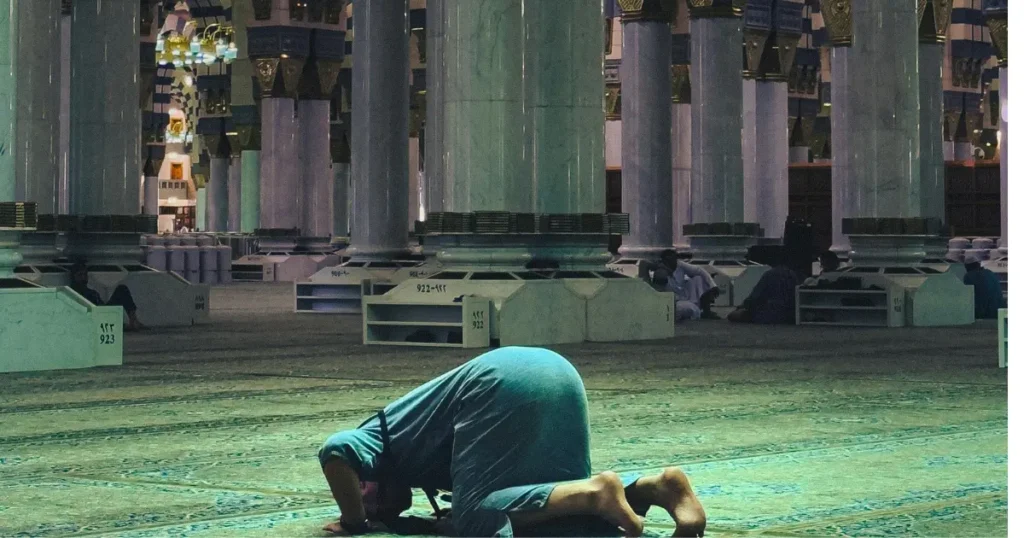
The visit to the Rawdah is complete — but your time in Masjid Nabawi is not. After leaving the green carpet, make your way to the salaam area near the Noble Chamber. Face towards the Prophet’s ﷺ grave and say: Assalamu alayka ya Rasulallah wa rahmatullahi wa barakatuh. You are greeted back — the authentic hadith confirmed this.
Then find somewhere to sit quietly in the mosque. Many first-time visitors need 10 to 15 minutes simply to be with what just happened. Pray your next salah here. One prayer in Masjid Nabawi equals 1,000 elsewhere.
What First-Timers Consistently Say Afterwards
There is a profound resonance in standing in Riyazul Jannah — the Garden of Paradise — and asking Allah to make your parent’s grave a garden of Paradise too. You are asking from inside the very thing you’re asking for. Many pilgrims who have made this dua describe it as the most emotionally powerful moment of their Rawdah visit.
📎 Full step-by-step visiting guide from hotel to Rawdah and back → How to Visit the Rawdah — Complete Pilgrim’s Guide