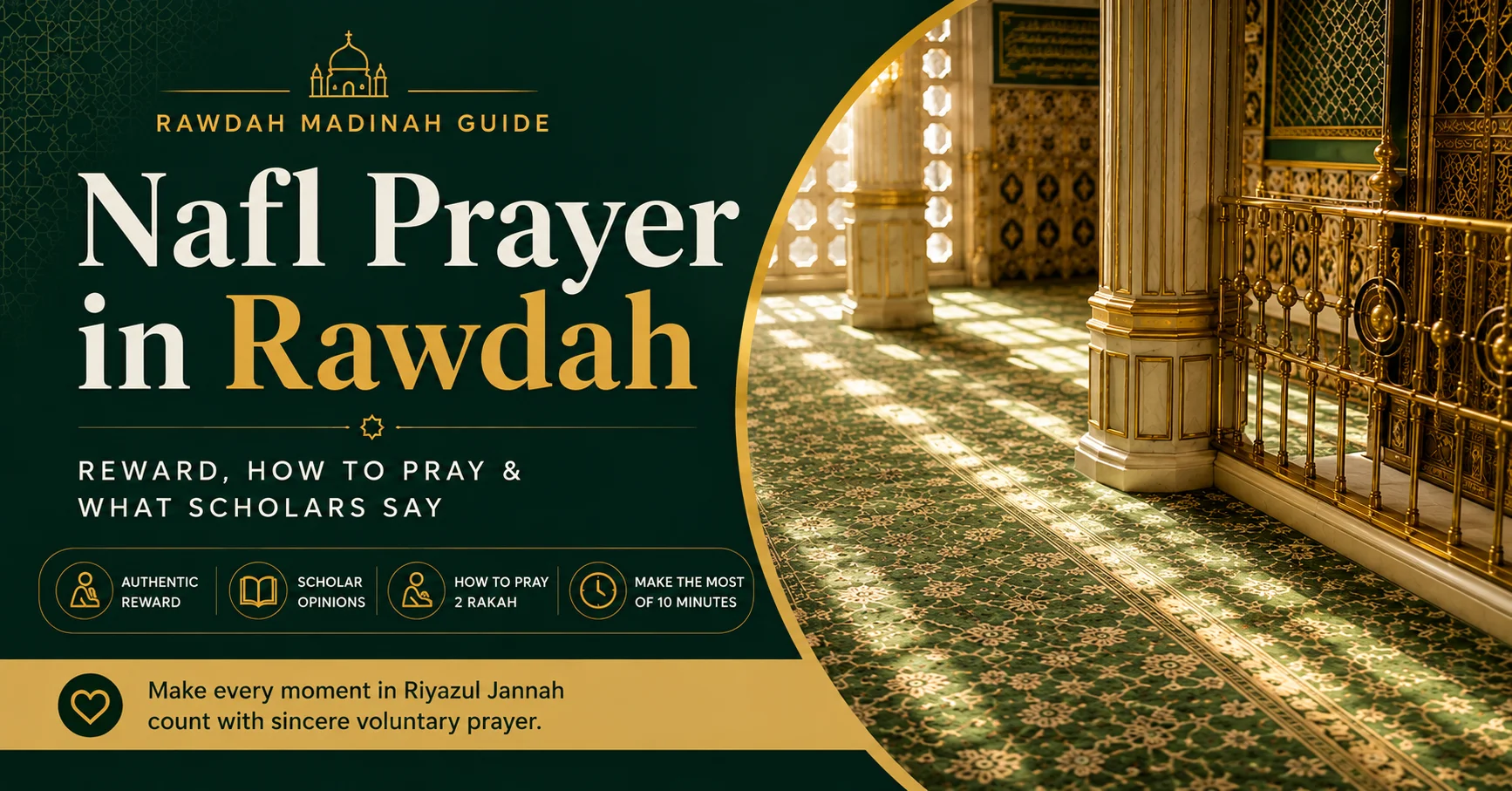
Praying two rakah of voluntary (nafl) prayer inside Riyazul Jannah is described by Islamic scholars as one of the most rewarded acts available to a Muslim pilgrim. The space itself — identified by the Prophet ﷺ as a garden from the gardens of Paradise — multiplies every act of worship performed within it. Preislam.com states clearly: “Praying in the Rawdah carries immense reward — scholars consider it among the most recommended voluntary prayers a Muslim can perform.”
But with only 10 minutes inside, the question becomes practical: should you prioritise nafl prayer or dua? This guide gives you the full Islamic basis, the scholarly opinion, and a clear answer on how to use your time.
Key Takeaways
The Islamic Basis — Why Nafl Prayer Here is Different
Every prayer in Masjid Nabawi carries 1,000 times the reward of prayer elsewhere — confirmed in Sahih al-Bukhari (Hadith 1190). The Rawdah carries an additional specific blessing beyond this general mosque excellence, because the Prophet ﷺ specifically identified it as Jannah on earth.
“What is between my house and my pulpit is a garden from the gardens of Paradise, and my pulpit is upon my fountain (Hawd).”
— Sahih al-Bukhari, Hadith 1196. Praying two rakah on this ground is prayer offered inside a garden of Paradise.
The combination — 1,000x reward of Masjid Nabawi, plus the specific Rawdah blessing — makes voluntary prayer here among the most spiritually dense acts available anywhere on earth. Preislam.com records the scholarly view: “The Rawdah is one of the most virtuous places in the world to perform prayer, remembrance, and supplication.”
Tahiyyatul Masjid — The Greeting Prayer
When you first step onto the green carpet, the recommended act is Tahiyyatul Masjid — the greeting prayer for the mosque. This is two rakah of voluntary prayer offered as a form of greeting and honour to the sacred space you have entered.
نَوَيْتُ أَنْ أُصَلِّيَ تَحِيَّةَ الْمَسْجِدِ رَكْعَتَيْنِ
Nawaytu an usalliya taḥiyyatal masjidi rak’atayn.
“I intend to pray two rakah of the greeting of the mosque.”
— The intention (niyyah) for Tahiyyatul Masjid. Said silently before beginning.
The prayer itself is standard — two rakah, recite Surah Al-Fatiha and any surah in each rakah, standard ruku and sujud. No specific surahs are prescribed. Many pilgrims recite Surah Al-Ikhlas (Qul huwa Allahu ahad) after Al-Fatiha for brevity given the 10-minute time limit.
How to Fit Nafl Prayer Into Your 10 Minutes
The 10-minute visit limit requires intentional time management. Two focused rakah of nafl prayer take approximately 2 to 3 minutes when recited at a measured pace. This leaves 7 minutes for dua — more than enough for a prepared pilgrim with a written list.
10-minute sequence with nafl prayer included
- 0:00 — Step on green carpet. Pause. Lower gaze. Begin salawat.
- 0:30 — Make intention for Tahiyyatul Masjid. Face qibla.
- 1:00 — Begin two rakah. Fatiha + Al-Ikhlas each rakah. Measured pace.
- 3:30 — Complete salam. Remain seated briefly in the prayer position.
- 4:00 — Raise hands. Open dua list. Begin supplications.
- 4:00–9:00 — Work through your duas: self, parents, family, ummah.
- 9:30 — Close with salawat upon the Prophet ﷺ.
- 10:00 — Move calmly when directed. Leave with gratitude.
Practical Insight
The key to fitting nafl prayer into 10 minutes is preparation — not rushing. A pilgrim who knows they’ll pray two rakah and has decided on the surahs beforehand can complete the prayer in under 3 minutes without feeling rushed. The mistake is deciding to pray after you’ve stepped inside. Decide before you enter.
📎 Get printable dua cards and give your parents to recite for you at Rawdah → Duas for the Rawdah Complete Collection
Full duas in Arabic, transliteration and English — including Sayyidul Istighfar, Durood Ibrahim, and duas for parents, health, rizq and Jannah
Tahiyyatul Masjid — The Greeting Prayer
The Rawdah can be crowded — especially during Ramadan, Hajj season, and post-Jumu’ah slots. If there is genuinely no space to perform the prayer postures safely, do not attempt to pray. Go directly to making dua. Islamic scholarship is clear that dua — sincere supplication — carries full reward independently of prayer. Your visit is not incomplete without the physical prayer.
The Prophet ﷺ taught flexibility in worship. If standing is not possible, sit. If prostration is not possible, indicate. And if prayer itself is not physically possible given the space, the intention to pray carries blessing, and dua remains fully open to you.
The Pillar of Aisha — The Most Recommended Spot
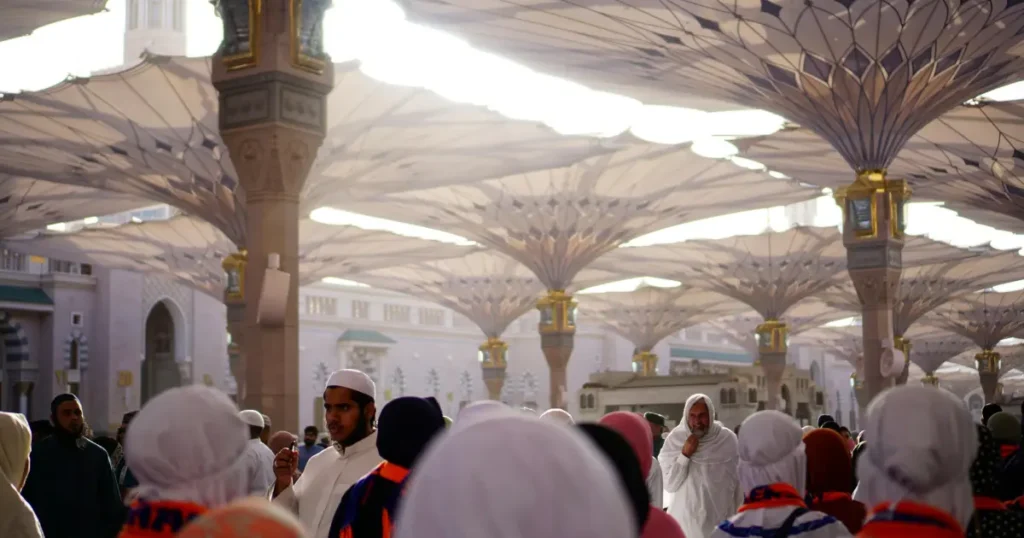
Within the Rawdah, the most recommended spot for voluntary prayer is Ustuwanah Aisha (RA) — the Pillar of Aisha. Sayyidah Aisha (RA) narrated that the Prophet ﷺ specifically prayed here frequently and recommended it to companions. Prayertimesksa.com confirms this pillar remains one of the most sought spots inside the Rawdah to this day.
If you can position yourself near this pillar — the one closest to the Noble Chamber on the northern row — and pray your two rakah there, you are following the specific recommendation of the Prophet ﷺ himself.
Learn about all six sacred pillars of the Rawdah → What is Rawdah Madina — Riyazul Jannah Explained
After the Prayer — Moving Into Dua
The transition from nafl prayer to dua should be seamless. After completing your salam, remain in your seated position briefly. Raise your hands. This physical posture — seated after prayer, hands raised — is described in authentic hadith as among the best times for dua to be accepted.
“The closest a servant is to his Lord is when he is in sujud (prostration), so make plenty of dua in it.”
— Sahih Muslim, Hadith 482. After sujud in the Rawdah, you transition to dua carrying the blessing of both.
📎 Full duas to recite after your nafl prayer — Arabic, transliteration, English → What to Pray in the Rawdah — Complete Spiritual Guide