
History & Knowledge · Cluster 4 · Rawdah Madina
The Six Pillars of the Rawdah —
Ustuwanaat Complete Guide
Complete duas, dhikr, and spiritual preparation for praying inside Riyazul Jannah — the Garden of Paradise inside Masjid Nabawi, Madinah.
⏱ 10 min read🏛 History
Running along the northern boundary of Riyazul Jannah — the Garden of Paradise inside Masjid Nabawi — are six marble pillars that have stood, in one form or another, since the lifetime of the Prophet Muhammad ﷺ. Al Jumuah Magazine describes them as standing on “the exact locations where the original pillars, made from palm tree trunks, stood after Masjid Nabawi was built.” Each has a name. Each has a story. Each marks a moment from the earliest days of Islam that changed the ummah forever.
Most pilgrims walk past these pillars without knowing what they’re looking at. This guide changes that.
Key Takeaways
📎 Full guide: Duas & Spiritual Guide — Complete Arabic duas with transliteration → https://rawdahmadinah.com/what-is-rawdah-madina/
Full duas in Arabic, transliteration and English — including Sayyidul Istighfar, Durood Ibrahim, and duas for parents, health, rizq and Jannah
Why These Pillars Matter
The word ustuwanah (أسطوانة) comes from the Persian word sutun, meaning a pillar of uniform circumference from top to base. Al Jumuah Magazine records: “From that time until the present day, those who rebuilt or extended the mosque were very scrupulous in preserving the original location of these pillars.” Across fourteen centuries of expansions, fires, and reconstructions, every Islamic ruler who touched Masjid Nabawi made one non-negotiable commitment: these six spots would not move.
That preservation is itself a statement. These pillars don’t just mark physical locations. They mark the moments and people through whom Islam was built — the companions who stood guard, sought forgiveness, prayed through the night, and received delegations from across Arabia. Walking past them inside the Rawdah is walking through living Islamic history.
“I saw the most famous amongst the companions of the Prophet ﷺ hurrying towards the pillars at the Maghrib prayer before the Prophet ﷺ came for the prayer.”
— Sahih al-Bukhari. The companions themselves competed to pray at these blessed spots.
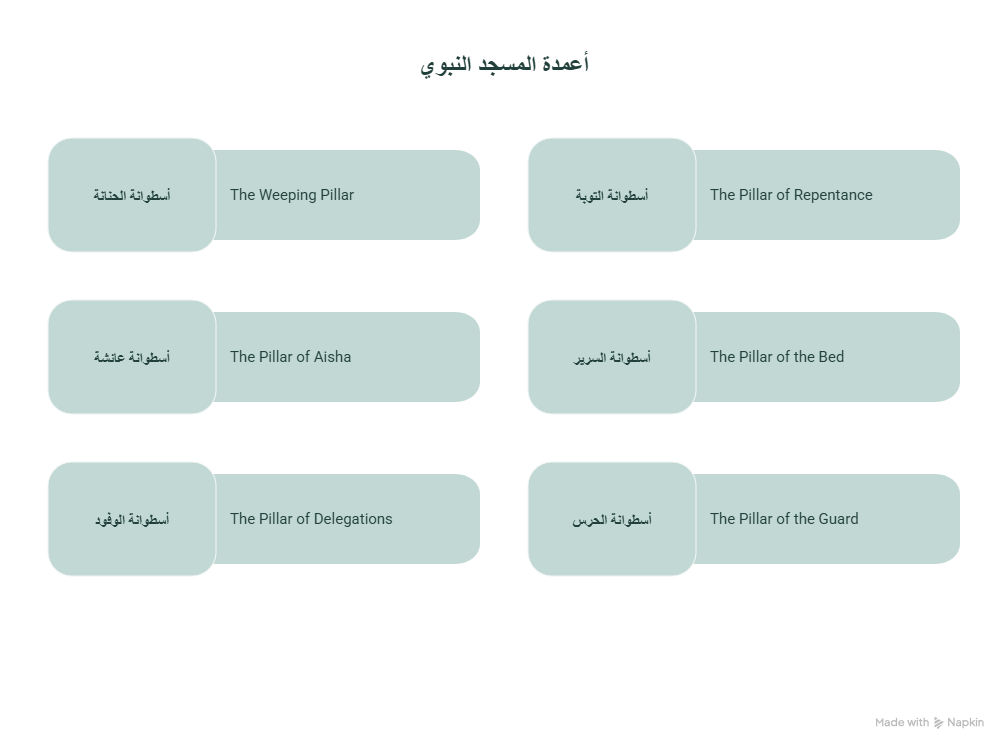
The Six Sacred Pillars — Each One Explained
Pillar 01 أسطوانة الحنانة
Ustuwanah al-Hannana — The Weeping Pillar
Also known as: Ustuwanah al-Mukhallaqah (The Perfumed Pillar)
This is the most historically extraordinary of all the pillars. It marks the spot where a living date palm trunk once stood — the trunk against which the Prophet ﷺ would lean while delivering his Friday sermons before the Minbar (pulpit) was built. When the three-step wooden pulpit was constructed around 7 AH, the Prophet ﷺ mounted it for his sermon. The abandoned trunk — which had borne the weight and warmth of the Prophet ﷺ every Friday — emitted a sound described in multiple authentic narrations as like the weeping of a child, or the moaning of a pregnant she-camel. The mosque fell silent. The Prophet ﷺ descended from the pulpit and embraced the trunk. It quietened.
Al Muslim Quran records: “Those in the mosque heard a deep sound — as if the trunk was weeping. The Prophet ﷺ then went to it and embraced it until it became quiet. This incident was reported by many companions and recorded in Sahih al-Bukhari and Musnad Ahmad.”
The Prophet ﷺ gave the trunk a choice: to be replanted and live again, or to be planted in Jannah so that the friends of Allah could eat from its fruit. The trunk chose Jannah. Dalail al-Khayrat records that al-Hasan ibn Ali wept when he told this story and said: “Slaves of Allah, the wood yearned for the Messenger of Allah ﷺ. You are the ones who should yearn to meet him.”
Source: Sahih al-Bukhari, Hadith 3584; Musnad Ahmad; narrated by Jabir ibn Abdullah (RA)
Pillar 02 أسطوانة التوبة
Ustuwanah al-Tawbah — The Pillar of Repentance
Also known as: Ustuwanah Abu Lubabah
In 5 AH, during the siege of the Jewish tribe Banu Qurayza, the companion Abu Lubabah ibn Abd al-Mundhir (RA) was sent by the tribe to ask the Prophet’s ﷺ intentions regarding them. In a moment of weakness, he gestured to them what would happen. He realised immediately that he had betrayed the Prophet’s ﷺ confidence.
Overcome with remorse, Abu Lubabah entered Masjid Nabawi and tied himself to the palm trunk at this spot, vowing not to release himself until Allah accepted his repentance. He remained tied for days, his wife bringing him food and water, refusing all offers to be untied. His repentance was accepted when Allah revealed Quran 9:102: “And there are others who have acknowledged their sins — they mixed good deeds with bad. Perhaps Allah will accept their repentance.”
The Prophet ﷺ came to untie him himself. Abu Lubabah said: “No, O Messenger of Allah, until you are the one to untie me.” The Prophet ﷺ untied him with his blessed hands.
Source: Quran 9:102; Tafsir Ibn Kathir; recorded in Sunan Abu Dawud
Pillar 03 أسطوانة عائشة
Ustuwanah Aisha — The Pillar of Aisha
Also known as: Ustuwanah al-Qur’ah (The Pillar of Casting Lots) · Ustuwanah al-Muhajireen (The Pillar of the Emigrants)
This is considered by many scholars the most blessed spot for voluntary prayer inside the entire Rawdah. Hajj Umrah Planner records: “According to Imam Malik, this is the best location to pray salah in Masjid Nabawi.
“Madain Project records the tradition behind the name: Sayyidah Aisha (RA) indicated this spot to the companions after observing the Prophet’s ﷺ devotional routine — she reported that if people knew how blessed this specific spot was, they would need to draw lots (cast ballots) to determine who could pray there. This is why it also carries the name Ustuwanah al-Qur’ah — the Pillar of Casting Lots. Hisar Travel confirms: “Sayyidah Aisha (RA) is reported to have indicated it as one of the Prophet’s favourite spots for voluntary prayer.”
It is located directly to the north-east of the Mihrab Nabawi. Today it is marked by a golden wreath with an inscription, making it identifiable to visiting pilgrims.
Source: Madain Project citing classical Islamic sources; Imam Malik, Al-Muwatta
Pillar 04 أسطوانة السرير
Ustuwanah al-Sarir — The Pillar of the Bed
As-Sarir means “the bed” in Arabic
This pillar is attached to the wall of the Prophetic Chamber. It marks the spot where the Prophet ﷺ used to place his blessed bed and mattress during the last ten nights of Ramadan when he performed i’tikaf — the spiritual retreat of intensive worship, Quran recitation, and prayer that the Prophet ﷺ maintained every Ramadan until his death.
Madinah Files confirms: “It is the pillar attached to the Prophetic Chamber. Here, the Prophet’s mattress would be placed during Ramadan for I’tikaaf.” Standing at this pillar connects the visitor to the Prophet’s ﷺ most intimate personal worship — the private devotion he maintained in the depths of the sacred month.
For pilgrims visiting during Ramadan’s last ten nights, this pillar carries a particularly resonant significance — the Prophet ﷺ himself observed i’tikaf at this very spot during the same period.
Source: Classical Islamic biographical sources (Seerah literature); Life in Saudi Arabia
Pillar 05 أسطوانة الوفود
Ustuwanah al-Wufud — The Pillar of Delegations
Also known as: Majlis al-Qalawah (Seat of the Nobles)
This pillar marks the spot where the Prophet ﷺ used to receive delegations — the tribal representatives, chieftains, and emissaries who came to Madinah from across Arabia to meet the Prophet ﷺ, discuss Islam, form alliances, and sometimes declare their people’s acceptance of the faith.
Madain Project records: “According to tradition this was used as a seat when the delegations of Arab people used to come. Historically, it was also known as majlis ul-qalawah (seat of the nobles), since the chieftains and learned Sahabah” gathered here. After Fajr prayers, the Prophet ﷺ would also receive the poor, the weak, the needy and guests at this spot — listening to their needs and concerns.
Madinah Files adds: “After the Fajr prayers, he ﷺ would receive the poor, the weak, the needy and the guests there. He ﷺ would listen to their needs and talk with them there.” This spot embodied the Prophet’s ﷺ dual role: statesman and shepherd.
Source: Madain Project; Madinah Files
Pillar 06 أسطوانة الحرس
Ustuwanah al-Haras — The Pillar of the Guard
Located near the Rawdah’s eastern edge
This pillar marks the spot where the companions of the Prophet ﷺ — including Ali ibn Abi Talib (RA) — stood guard to protect him. In the early years of Islam, before the revelation of Quran 5:67, some companions feared for the Prophet’s ﷺ safety and voluntarily stationed themselves near his home to watch over him.
Alhannah Blog describes: “Near the Rawdah’s eastern edge, this marks where companions such as Ali ibn Abi Talib stood watch over the Prophet’s private residence.” When Quran 5:67 was revealed — “And Allah will protect you from the people” — the Prophet ﷺ told his companions they no longer needed to guard him. He had Allah’s protection. The companions who had stood vigil at this spot were released from their duty.
The pillar stands as a permanent witness to the devotion of those companions — who loved the Prophet ﷺ enough to sacrifice their sleep and safety for his protection, before Allah confirmed that His protection was sufficient.
Source: Quran 5:67; Alhannah Blog; classical Islamic biographical sources
How to Find the Pillars During Your Visit
Hisar Travel gives practical guidance for pilgrims: “The most-referenced pillars stand within or just beside the Rawdah — observe pillar markings and small plaques. Ask a mosque guide politely if unsure.” Ustuwanah Aisha (RA) is the most identifiable — it’s marked by a golden wreath with an inscription. The Weeping Pillar (al-Hannana) stands behind the Mihrab Nabawi.
How to approach the pillars respectfully
- Move to any pillar area calmly — don’t push past other worshippers
- Praying two rakah near Ustuwanah Aisha (RA) is specifically recommended by Imam Malik
- If the area is crowded, pray wherever you can — the entire Rawdah carries its blessing
- Follow current signage and mosque staff directions — access to specific pillars varies
- Don’t touch or lean against the marble pillars — maintain respectful distance
- Use your 10-minute permit time for prayer and dua — not for locating each pillar individually
Unique Insight
The six Ustuwanaat are not just historical markers — they are a complete moral curriculum. One teaches repentance (al-Tawbah). One teaches yearning for the Prophet ﷺ (al-Hannana). One teaches that some spots are so blessed even the companions competed for them (Aisha). One teaches the Prophet’s ﷺ personal worship (al-Sarir). One teaches his public leadership (al-Wufud). One teaches devotion unto itself (al-Haras). Taken together, they describe what a Muslim’s relationship with the Prophet ﷺ looks like in practice.
📎 What is the Rawdah? Full history, location and significance → What is Rawdah Madina — Riyazul Jannah Explained